

written by Katharina Felicitas Heilmaier
Europe invests around €120 billion a year in the circular economy. According to the EIB, the annual investment gap still stands at €82 billion, and it is widest where it matters most: in circular design and end-of-life infrastructure, and in construction, batteries, vehicles and textiles. The ventures are emerging. The capital that understands them, though, is still scarce.
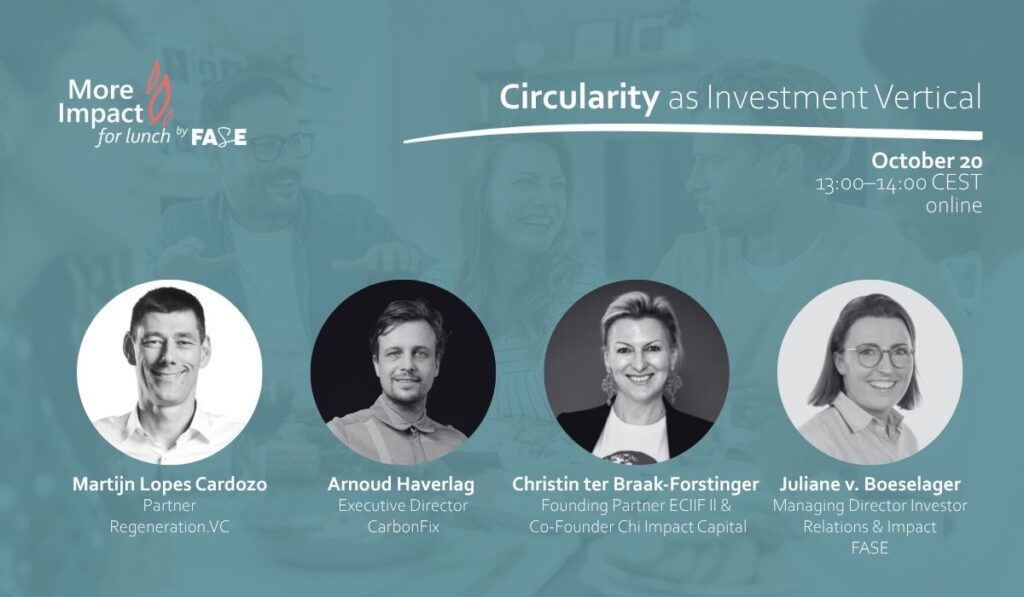
That was the starting point of our More Impact for Lunch on 20 October. Together with Arnoud Haverlag (Executive Director, CarbonFix), Dr. Christin ter Braak-Forstinger (Founding Partner, European Catalytic Impact Investing Fund II) and Martijn Lopes Cardozo (Partner, Regeneration.VC), we discussed what makes circularity an investment vertical and where concrete opportunities arise for investors. Juliane von Boeselager, Managing Director Investor Relations & Impact at FASE, moderated. Four takeaways stand out.
Takeaway 1: Circularity keeps value in the economy
Circularity keeps value in the economy instead of writing it off. The World Economic Forum estimates that the transition could generate $4.5 trillion in additional economic output by 2030. It is also a climate lever: roughly half of carbon emissions are tied to products and materials. Investors who understand that shape where the value lands. The leverage sits at the start of the chain, in design. Toxic anti-fouling paint on ships harms marine life and releases microplastics. A robot that cleans the hull mechanically makes the paint unnecessary: the problem is solved at the source. What cannot be designed out can be reused. When one company captures CO2 and another turns it into a product, waste becomes raw material. For investors, the strongest cases are chains like this, not single companies.
„We’re running a linear economy on a finite planet. And if you care not just about carbon, but about all the other planetary boundaries, that’s really where circularity comes in.“
Martijn Lopes Cardozo, Regeneration.VC
Takeaway 2: Adoption beats invention
Invention is not the bottleneck. Great materials and models exist, and adoption decides which of them scale. In circularity, the buyer is often not the end customer and the supply chains are long. That costs time, and time is what capital rarely has. Specialized investors therefore work with leading brands that use the product, co-invest and sit in the diligence. Pull, not push. Two more constraints came up. Investors rarely pay a green premium, so the winners do not sell a greener alternative, they build convenience into the whole solution: for mainstream consumers, convenience beats environmental awareness.
„The most successful companies don’t offer just a greener alternative. Convenience is integrated in the whole solution.”
Dr. Christin ter Braak-Forstinger, ECIIF II
Takeaway 3: VC is one tool, not the toolbox
Venture capital is a strong fit where technical innovation drives fast scaling. Other models call for a different financing logic. Capital-intensive businesses in deep tech, production or recycling often benefit from patient capital, with longer horizons and, at some point, repayment from cash flows instead of an exit. Steward-owned companies, whose founders do not plan to sell, are a similar case. The transition needs every form of capital, from philanthropy to venture capital, and allocators have to be ready for it. The opening is there: many startups work on circular solutions, few funds specialize in them, and deal flow goes to those who build expertise.

Drohne_Sonnenuntergang (Copyright: everwave)
Takeaway 4: A circular mandate anchors a strategy in the problem it solves
Mission drift means a company or fund slowly moving away from the problem it set out to solve, usually because decisions follow returns and trends instead of the mission. The first protection sits with the investor. A clear circular focus keeps a strategy tied to the problem, in venture capital as well as in other forms of financing. The logic is reversed: instead of fitting nature into return models, investors ask how their capital can work within nature’s limits. The second protection sits in the business model. In some models, the more the company sells, the more impact it has, so commercial success and mission cannot drift apart. Such models are only one part of the opportunities. The question to ask a venture: does your impact grow with your revenue? Where it does, robustness is built in. Where it does not, the focus helps, but the business model will not protect the mission on its own.
Where the opportunity sits, why now and where to start
The opportunity is the gap: €82 billion a year, widest in design and end-of-life infrastructure, with many startups and few specialized funds. The timing is right, because thematic specialists are emerging alongside generalist funds and published methodologies make circularity measurable. To start, pick a theme you know, test whether a venture’s impact grows with its revenue, and look for a leading brand as adoption partner.
Further reading
European Investment Bank and European Commission (DG ENV): Transitioning to a circular economy: Closing the investment gap in Europe, April 2026
Circle Economy and Deloitte: Circularity Gap Report 2026: The Value Gap, April 2026
World Economic Forum: Making the $4.5 trillion circular economy opportunity a reality
FASE: Case study on everwave, a circular economy venture whose financing round FASE supported
About the organisations
CarbonFix is a climate-focused single family office that deploys capital where conventional finance falls short, across three mandates: philanthropy for what the market cannot yet fund, catalytic capital where its involvement changes outcomes, and performance capital backing the best climate operators. With 20+ grants, 30+ direct deals and 25+ fund investments, it acts as an active partner.
Regeneration.VC is a VC fund specialized in circularity across consumer value chains, from food and textiles to electronics and hygiene. Fund II invests in Late Seed and Series A circular ventures in Europe and globally.
ECIIF II, the European Catalytic Impact Investing Fund II, is a pan-European co-investment fund and the successor to ESIIF, co-initiated by FASE and CHI Impact Capital. Using a catalytic capital structure, it provides patient capital to impact ventures in four verticals: education & employment, health & care, circular economy & climate action, and food & agriculture. The fund reached its first close at €21+ million in September 2026. It is managed by Innpact and advised by Catalytic Impact Partners, a partnership between FASE and CHI Impact Capital.
